
What is Judicial Misconduct?
In a nutshell, judicial misconduct is exceptionally broad and includes a plethora of activity, any one of which could or would stand to bring the integrity of a given court into question. First and foremost, it is important to understand the distinction between the types of judges and their judgeship.
- District Judges: The President nominates federal district judges. For the most part, barring exceptional circumstances, the confirmation of federal judges is cursory. Unless the Senate chamber finds something particularly disturbing about a given judge's background, the nomination is usually confirmed with little inquiry. Once a federal judge is confirmed, their tenure is for a lifetime; however, the qualifier under the USA Constitution is that a district judge’s tenure requires “Good behavior.” Federal judges are referred to as Article III judges, since Article III of the United States Constitution is the authority of their judgeship. These judges have very broad judicial powers including both Law and Equity, which is legalese.
- Magistrate Judges: Unlike district judges, magistrate judges are appointed by Congress for a limited term. Generally the term ranges 4-6 years, and upon expiration, a public notice is typically posted on the district court website where the magistrate judge is serving, with the intent of garnering ‘Public feedback’ on the reappointment of the magistrate in question. Magistrate judges have no equitable powers, and their judicial powers are specifically enumerated by federal statute which requires consent by the parties for a magistrate judge to exercise jurisdiction. In reality, magistrate judges are the next rung of an attorney wearing a judicial robe endowed by Congress to possess certain judicial powers, ante. Magistrate judges are highly susceptible to political influence, especially by Congress, who appoints them. This category of judgeship can and mostly includes immigration judges.
So judicial misconduct occurs when either a district or magistrate judge acts outside of his or her jurisdiction, e.g. misfeasance or malfeasance. Also, as the entire court system rests on the integrity of judges, judicial behavior even outside of work can be a factor in considering judicial misconduct events.
How Does Widespread Judicial Misconduct Enter the Picture?
In short, widespread judicial misconduct enters the picture when judges, especially district judges who, ante, possess broad powers -- misuse the bench to advance a personal agenda, are found guilty of a misdemeanor, other civil misconduct, criminal misconduct, or even filing for bankruptcy.
What is particularly common place in today’s modern society is that district judges engage in judicial activism e.g. advancing personal agenda or ideology, as opposed to dealing specially with the facts and rule of law or in the case of Equity, exercising sound impartial judgment. When judicial activism infects a number of districts and further spreads to higher circuit courts, this is the condition described as widespread corruption or for the layman the term ‘Kangaroo Court.’
Widespread corruption Rules United States Courts, far beyond simply assuming the status of Kangaroo Courts. The United States federal courts have become the de facto home for judicial activism and extremely egregious human rights violations.
The FBI Freedom of Information Act Lawsuit Illustrates Real World Judicial Misconduct
As a backdrop, the herein referenced Freedom of Information Act (FOIA) lawsuit was originally filed back in July of 2021. At no point did the FBI ever release a single piece of paper relative to the FOIA action. Even worse, at least three times this case has been in the federal court of appeals for the second circuit which is situated in New York City, NY. None of the issues ever raised in the second circuit court were ever addressed. Not one. This is judicial misconduct in the circuit court, specially the Federal 2nd Circuit Court of Appeals.
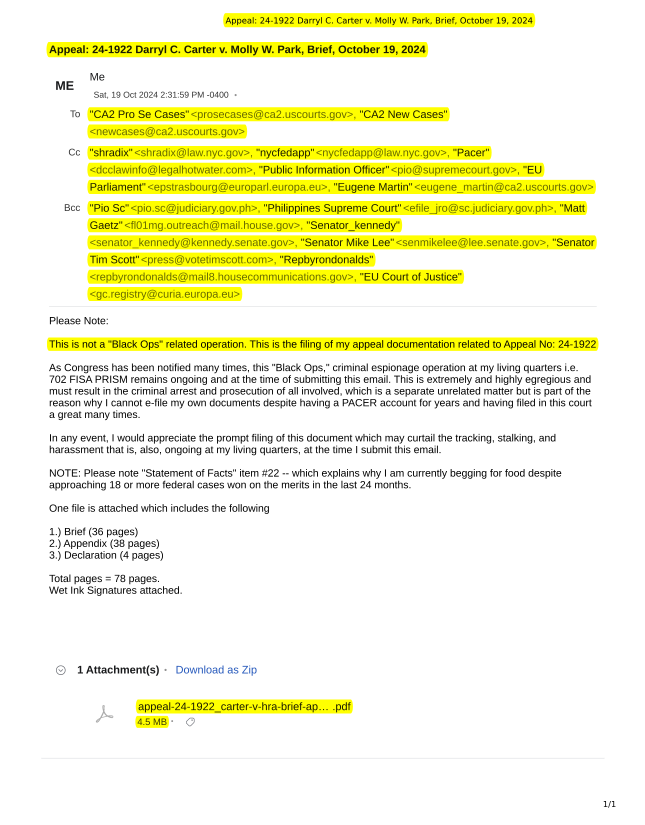
In fact, this latest instance, like its predecessors, did not even involve a single affirmative paper being filed, in the appeals court, by the defendant i.e. The Department of Justice. For those unfamiliar, the Department of Justice is the parent of the FBI. While the FBI has its own director, the FBI, also, reports, via its director, up to the attorney general of the Department of Justice. Continuing, in each appeal instance, the appeal was dismissed and immediately reassigned to a Chinese clerk by the name of Yenni Liu. Documents are illustrative of this judicial misconduct and public corruption. Be sure to read the second set of documents on the next page.