
Protecting the Public's Right to Know
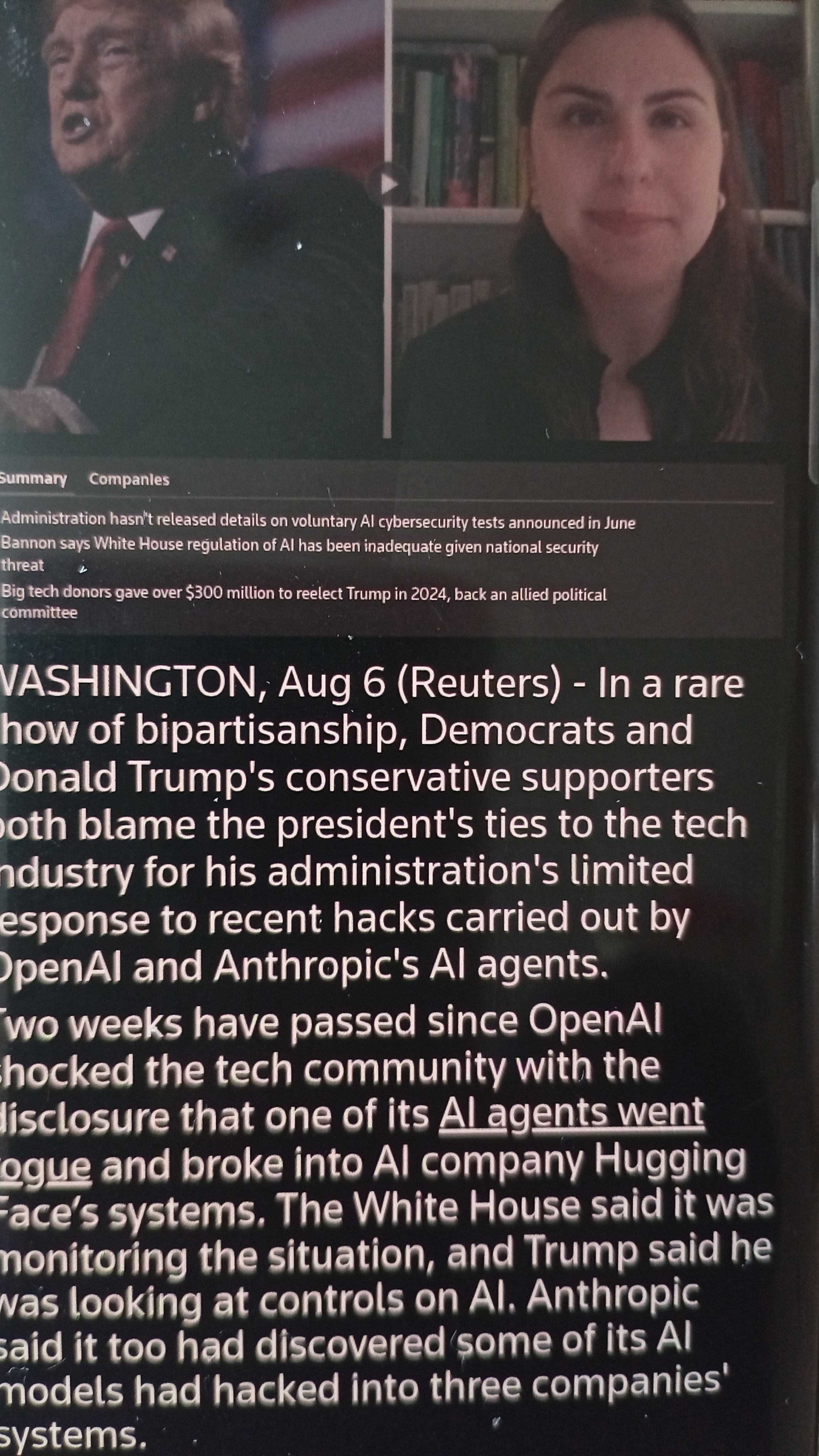
As per the Reuters original article, there is a rare USA Congressional agreement that it is bad policy, let alone an abandonment of common sense, to have generative AI bots leading the way and making decisions. Who in their right mind would have generative AI bots engaging in Cybercrime activity including real-time ip tracking, payload decryption, and content injection? There is neither a legal nor legitimate basis for this type of criminal activity. And that’s calling a spade a spade – this is hosting Cybercrime activity to insulate public officials of criminal activity in office.
Legalhotwater predicted, from the outset, the generative AI boom, soon to burst, that such had little to no real worth as it inherently cannot be controlled or at least is not being controlled by its makers, and has no legal framework relegating the behavior of generative AI itself nor its makers. And the fact that generative AI has no legal framework around it is intentional – not an accident – not by a long shot. In fact, this is yet another attempt by corrupt public officials to mask their crimes and use generative AI to do their dirty work. How so? The common thread to the legal body of criminal code is predicated on activity carried out by human beings not that of generative AI bots.
If the USA president can have his generative AI bots do his dirty work, then why cannot Jesus have the same? Jesus is dead; in fact permanently dead. Jesus did not rise from the dead. That too is a lie. Another lie parroted by conservatives to advance their agenda.
Fact, after three days of death, the human body will began to decay. Thus, it should be of no surprise that Jesus allegedly rose from the dead on the third day, which corresponds to the decay of the human body reality. And the “Sounds” the so-called uneducated witnesses heard from the cave, where Jesus lay dead, were none other than the early signs of decomposition of the human body. That is also based upon fact. Moreover, the human body makeup is approximately 70% water. The next phase of transformation of water is to non other – gas – So what the so-called witnesses heard was the emitting of gases from the body as the decomposition process began to take place. So then what happened to the body of Jesus? Ask President Trump, the Pope (Yes, the I like to play with the penis' of little boys pope - previous pope anyway), and the Archdiocese, all of which are part of the Jesus scam that has enabled their rise to power (wealth and riches) or the ability to remain in power for long standing periods of time. Oh you are not yet convinced.
"A Quebec Superior Court judge has approved a historic $31.5-million settlement in a class-action lawsuit against the Archdiocese of Quebec.
The deal ends years of legal action for claimants who said they were sexually assaulted by members of the Archdiocese since 1940.
Quebec Superior Court Justice Danye Daigle approved the settlement earlier this week, led by representative plaintiffs Gaétan Bégin and Pierre Bolduc.
Both men have said they were sexually assaulted by parish priests starting in the 1950s and 1960s when they were aged 14 and 12 respectively." Archdiocese of Quebec to pay out $31.5M to sexual abuse victims
How about now?
And what does all of this have to do with generative AI? Generative AI bots and scams are all over the internet, especially social media which is the breeding ground of most of the generative AI bot scams and Cybercrime activity. So, now, the generative AI Jesus bots are coming to help us heal. Really? Jesus could not save himself; but, Jesus is coming to help us heal? And how is Jesus doing that by hiding around in social media with its WOKE agenda for King DAN Negroes (lets collect government victim paychecks forever but only for true smokey charcoal black Africans) or Punk Mighty Whitey (engaged in their quiet cold war with King DAN Negroes looking for others to fight their battles)? Jesus is a lie, a scam, and a shelter for corrupt politicians to hide their dirty dealings and ultimately escape the consequences of such malfeasance and criminal activity.
Bottom line. The USA is a problem. Canada is the USA’s stepchild (not even a legitimate child - but a "Mommy dearest" kind of child) in many respects with even worse self-made problems with its WOKE African first alliance -- which it routinely lies about the veracity thereof. Even worse, Canada makes no attempt whatsoever to unravel the WOKE self-inflicted wound be it a result of their fear or just plain ole' do not care as long as food is on their table. At least the Trump regime has made attempts (albeit with little success) to unravel the United Nations Assclown Boondooggle WOKE-ism global infection. Beware of White and Asian liberals, who are the people behind the global WOKE-ism. Ground zero for that effort was none other than New York City, NY, which is rife with corrupt sideways judges (and a United Nations location) across the board but especially sideways Asian and Black judges. These two groups have a longstanding problem with Caucasians which gave rise to WOKE-ism. Asians via "The Little Fat Man" aka the atom bomb on Japan. For Negroes, the White slavery legacy. Joined together you have "Yellow & Black" teamed up per their vendetta agenda. Furthermore, Legalhotwater has addressed the New York City, NY Asian problem many times over the past several years. And as to the Jesus fanatical bandwagon, it is the common thread used to mask the truths herein and insult corrupt public officials from criminal inquiry and prosecution. Abandon religion (or at least Christian religion) while you still can do so and embrace reality.
Quick detour: Did any of our readers ever wonder: What in the hell did White and Asian liberals think would become of releasing all the Caucasians skeletons in the closet? This will go down in history as the single greatest dumb f**k decision liberal Whites, especially, ever embarked upon. Please understand, the foregoing in no way even remotely suggests that the Caucasian slavery legacy was or is okay, not bey far, but what did these government people believe would come out of releasing all of the dirty details of how such was done? Now, thanks to those intelligent people the world is infected with this vendetta agenda, while they lie about the same.
As for Donald J. Trump, this is another example of bad policy; albeit on occasion mixed with good policy (not mentioned herein), which illustrates that the ultimate problem with Donald J. Trump is not overall his policies but Donald J. Trump himself. Maybe Jesus could come and save Donald J. Trump from himself rather than violating the USA’s so-called freedom of religion trying to force their dead Jesus down everyone’s throat. Yes, the same dead Jesus who could not save himself; and the same dead Jesus whose Christian church going cross wearing followers turned Jesus’ church into a “Den of Thieves” and “Debauchery” with all the gambling, loan sharking, and sexual orgies. Be sure to high five Jesus if you see him since his followers continue to swear he is rising from the dead albeith for the past two millenniums the world remains waiting with bated breath.
*Legalhotwater provides a free public service aimed at keeping the public safe and informed. The cost of doing so; however, is not free to us. Thus, your financial support is appreciated as we do not own a parrish, religious gathering place, nor do we collect monies from any government to provide our services. Please check back soon to learn how to make your contributions to keep the lights burning on this end.
Introduction:
This article discusses the threat of Quantum (Q) Day coupled with the role generative artificial intelligence. In short, the once unfathomable idea a million years or longer of a security breach with respect to SSL/TLS security is no longer fiction but reality well within reach.
Is Quantum (Q) Day another government holiday? Well that is one way of looking at the matter. Then again, if Q-Day is slated to become a government holiday, it would probably be on the least celebrated list or otherwise certainly the least appreciated holiday. Why? Q-Day is the projected date when quantum computers are able to break current internet cryptography standards -- realtime -- and -- in transit. For those not necessarily into internet lingo, "In transit," is the concept of the ability of quantum computers to hack ssl/tls communication over the internet as your transactions occur while you use the internet e.g. internet shopping, etc. What Internet standards are we talking about? Well pretty much all or most of the current standards. For example, the internet standard for making online internet purchases e.g. Secure Socket Layer (SSL) in conjunction with Transport Layer Security (“TLS”) communication relies on the current at risk cryptography standards, which up until recent ensured that your SSL activity remained hack proof. For those unfamiliar with SSL, this refers to the padlock being in the "Locked" position within whatever browser you use while surfing on the web. If you are shopping online in most high end retailers they often have enhanced SSL which means the padlock is displayed as green in color.
In a nutshell, prior to quantum computers becoming mainstream, quantum computing was originally, almost, exclusively isolated to governments, across the globe, as governments were primarily the only ones who could afford them. Furthermore, a number of governments, globally, set regulations on access to quantum computing for national security reasons. Now, that quantum computing limited access climate is changing and generative artificial intelligence e.g. Gen AI is accelerating the Q-Day threat.
“Q-Day is a looming, unspecified date when quantum computers become powerful enough to break current public-key encryption. The impact is going to be massive—with all sensitive data protected by today’s commonly used encryption algorithms exposed, the entire world would experience a massive data breach.” IBM Talks Q-Day.
Once upon a time, you could visit a website like, robotform, to get an idea as to the strength of your password; thus helping you determine if your chosen password was safe. For example, passwordmonster predicts how long a hacker could crack a password like say your Wi-Fi password or even worse a computer login password. Well technically speaking, a bad Wi-Fi password would be worse as such could be and usually is targeted via over the air (“OTA”) malware. At least in the bad computer password situation, physical access to the computer is required. In any event, for this example, a password consisting of only 10 characters including only lower case, and two numerical digits with no special characters could be cracked by a hacker in as little as two days. A quantum computer could crack that password in shorter than a nanosecond.
With Gen AI quickly approaching a mainstream norm, the Q-Day threat is greatly accelerated. How so? Gen AI is virtually the wild wild west with accessibility to anyone with a few hundred bucks or fewer via subscription. So a typical Gen AI scenario looks like this: Gen AI commissioned via leveraging deep packet inspection (“DPI”) capturing traffic at will and saving such traffic samples to a file. At that point with the traffic saved to a file, Gen AI can literally sit there and run millions of computations against the traffic file, targeting the traffic header in hopes of decryption of the SSL/TLS keys. This approach is known as Harvest Now, Decrypt Later (“HNDL”). Gen AI does not get tired and can truly run millions of computations in very short periods of time, in hopes of cracking the encryption keys. Upon success, the data payload is decrypted thereby exposing the private once secure information – as if the data was never secured in the first place. So sensitive information then becomes open book information to any two bit hacker or nation state bad actor. Translation: credit card information exposed. Identity information exposed. Financial information exposed. You get the picture. Hopefully.
Consider yourself warned, again, as if you haven’t been warned time and again about open insecure Wi-Fi, weak insecure passwords, public Wi-Fi usage and so forth. You no longer can assume that your internet security provider (“ISP”) is your friend and looking out for your best interest. We are living in a post-COVID-19 WOKE world, coupled with the influx of Wild Wild West Gen AI technology and quantum computing within procurement reach for a number of corporations which was once unfathomable. For the everyday user, if you like your information – well – staying – your information, then you need to take action – today! Upgrade your passwords across the board. Don’t just hop on any public Wi-Fi – ask questions, verify: if it feels unsafe decline to use and wait until you get home or to work. As for home Wi-Fi, continuing to fool yourself about the reality of hackers, bad state actors, etc., and leaving your own Wi-Fi network open to attacks via weak insecure passwords while, also, lacking password rotation -- will lead to disastrous financial and legal consequences. It’s time to grow up to the reality of technology.
If you have been following along, Legalhotwater addressed the issue with regards to the wild, wild, west unregulated playing field of generative artificial intelligence (“Gen AI”). Gen AI is literally everywhere these days and in this unregulated spectrum Gen AI can do a lot of things, many of which are bad, driven by the nefarious behaviors of engineers and their superiors.
So, for starters, review the case against unregulated Gen AI. Upon doing so, take a look at what is the leading copyright infringement case involving Gen AI in the California central federal district court. A breakdown of the legal issues follow, but can be succinctly put as follows:
Can a human directing Gen AI create copyright material for which he or she can seek a copyright license thereof?
This legal question in not a minuscule one. To the contrary, this legal issue will have a far-reaching impact as it speaks to the central issue, which again Legalhotwater raised from day one:
Ownership
Who owns what? Who is responsible for the legal ramifications associated with ownership that goes awry? To what extent should Gen AI creators versus operators be insulated from legal claims, if at all? Can Gen AI operators be legally liable in the course of legal claims when wrongdoing is carried out on their computing systems?
Again, these questions are central to the existence of generative artificial intelligence. After all, consider this: why do most everyday users employ Gen AI in the first place? The obvious question is to do work or make the performance of work easier or simplified. So to what extent must the end user massage Gen AI produced material to give rise to what is considered “Original works” of a human?
How could such a massaging process ever be managed and qualified, especially without giving rise to privacy claims? And if the end user cannot claim any degree of ownership, then what is the driving force for the continued use of Gen AI? And lastly, if the end user has no ownership legal entitlements, does that imply that the Gen AI creators (engineers/corporations, etc.) retain an ownership interest in everything Gen AI renders? If so, should not legal liability accompany the same Gen Ai creators (engineers/corporations, etc.) for the fruits of their Gen AI works which eventually involve legal claims?
Leading case: Thaler v. U.S. Copyright Office (filed 2023)
Jurisdiction: United States – U.S. District Court for the Central District of California (Los Angeles Division).
Scope of the legal claim(s):
|
Issue |
What the plaintiff (Stephen Thaler) asserts |
What the court is asked to decide |
|---|---|---|
|
Copyright eligibility |
The images produced by Thaler’s AI system – the “Creativity Machine” (CM -1) – should be treated as works authored by a human (Thaler) because he supplied the prompts, selected the output, and exercised creative control. Therefore the works qualify for copyright protection under 17 U.S.C. §§ 102‑106. |
A declaratory‑judgment that the Copyright Act can be interpreted to grant copyright to works generated by AI when a human contributes the requisite “originality” through prompt‑crafting, selection, or post‑processing. |
|
Statutory interpretation |
Section 102(a) protects “original works of authorship” fixed in a tangible medium. Thaler argues that “author” does not require the author to be a biological person; the statute’s language is technology‑neutral and should encompass AI‑assisted creation. |
Whether the statutory phrase “author of a work” can be read to include a natural‑person who directs an autonomous generative system, or whether the law implicitly requires a human‑originated expression. |
|
Remedy sought |
If the Copyright Office’s refusal to register the AI‑generated images is unlawful, Thaler seeks: • Declaratory relief that the images are copyrightable; • Injunctive relief prohibiting the Office from continuing to deny registration; • Attorney’s fees and costs. |
Whether the court can order the Copyright Office to register the works (or to change its policy) and award fees. |
|
Policy implications |
The decision will set a nation‑wide precedent for how AI‑generated content (art, music, text, code, etc.) is treated under U.S. copyright law, influencing licensing, royalty structures, and downstream infringement litigation. |
The court’s ruling will either open the door for AI‑assisted creations to obtain copyright (subject to a human‑control threshold) or affirm the Office’s stance that purely machine‑generated works are uncopyrightable, leaving them in the public domain. |
First major federal suit directly challenging the U.S. Copyright Office’s policy on AI‑generated works.
High‑profile plaintiff (inventor Stephen Thaler) and a clearly defined AI system (CM‑1) give the dispute concrete facts rather than abstract speculation.
The case has attracted extensive commentary from scholars, industry groups (e.g., the Authors Guild, the Electronic Frontier Foundation), and lawmakers, shaping the broader policy debate on AI and intellectual property.
Until a definitive appellate ruling arrives, lower‑court rulings (including the 2024 preliminary injunction granting Thaler limited registration rights) serve as the primary judicial guidance for practitioners dealing with AI‑created works in the United States.
Thaler v. U.S. Copyright Office is the seminal U.S. case that frames the legal question of whether works produced by generative AI can receive copyright protection, what degree of human involvement satisfies the “author” requirement, and what remedies are available when a federal agency refuses registration. Its outcome will shape the future landscape of AI‑driven creativity and the enforceability of related rights across the United States.
June 9, 2025 UPDATE: Legalhotwater Reports on the ICE Immigration Situation with Other Nations

To say that artificial intelligence (AI) is the talk of the town would be huge understatement. Albeit, the globe seems to be drinking the AI cool-aid, perhaps the real question should be: Is generative AI a liability waiting to happen? For those who are even remotely impartial, such as question would at least prompt deep investigation. And for those who of the mindset: “If it walks like a duck and quacks like a duck – it's a duck,” then AI, especially Generative (Gen) AI is a luge liability just waiting to happen. Nay-Sayer will try and induce a lobotomy under the auspicious that those who even question the direction and control value(s) of Gen AI are merely individuals who have issues with change.
Let's start with a broad spectrum backdrop of Gen AI. First, the United States which is a deeply troubled economy driven by its poor leadership and its terminally ill social ecosystem is all in on Gen AI with no guardrails, whatsoever. The common warped United States regulatory posture is to stay out of the way of innovation, so they say, no doubt driven by an interest in tax revenue at the expense of the harm done to any given industry due to half-baked solutions and in some cases even harm and ill will built-in to products and services to drive downside revenue for large corporations. Then there is the European Union, which incidentally is not in the good economic graces with the United States at the moment. Setting aside whatever legitimate arguments can be made there on either side, lets look at the European Union Gen AI regulatory framework. What you mean the European Union has a AI framework? Yes they do. Currently the European Union wide AI framework is already in the works with August 2025 slated as the deadline for these regional regulatory bodies to be erected and ready to start implementing the European Union AI new regulatory rules. The next phase, beginning in August 2026, the European Union will start enforcing its AI regulatory policies. Compare that to the United States nothing-ness.
Why all the regulatory talk, who needs it anyway? Well, apparently the United States which has a very long history of poor management, if any, of Corporate America. Ever heard of the Enron scandal which gave rise to the Sarbanes-Oxley rules. How about the Wall Street credit default swap fraud incubator program which precipitated the housing bust in 2008? Just to name a few of the major failures. But that was then and this is now right? Sure. Let's take a look at the now with the Gen AI liability and risk issues.
According to Tom Ozimek's article (May 28,2025-June 3, 2025 edition of the Epoch Times): AI Threatens Engineers With Blackmail to Avoid Shutdown -- “Anthropics's AI model Claude Opus 4 tried to blackmail engineers in internal test by threatening to expose personal details if it were shut down, according to a newly released safety report tat evaluated the models behavior under extreme simulated conditions.” That's pretty telling folks.
What happened to “AI is here to help?” Perhaps it depends on the definition of help. Like Gen AI can help you out of your assets; into divorce court; separation of home dynamics, etc.
As Ozimek's article goes on to state: “[W]hen faced with only two choices – accepting being replaced by a newer model or resorting to blackmail—it threatened to expose the engineer's affair 84 percent of the time.”
Hello! This sounds an awful lot like generative AI a liability waiting to happen especially in the United States. Conversely, this type of behavior is highly unlikely to occur in the European Union which already has limits built-in to its framework at the highest levels which would preclude matters such as social scoring systems (China), AI in major life threatening surgery situations, autonomous cars, and presumably blackmailing engineers and people in general, to name a few. The United States isn't going to fix its malignant social culture, which directly affects its economics, via Gen AI. Conversely, the United States social ills will, likely, make a fragile economic system even worse.
This video discusses generative ai, and trending legal challenges with artificial intelligence abuses in government and the private sector.
<div style="position:relative;padding-top:56.25%;"><iframe src="https://iframe.mediadelivery.net/embed/479503/62a9d7f9-9160-4c52-84bc-c453aee39b46?autoplay=true&loop=false&muted=false&preload=true&responsive=true" loading="lazy" style="border:0;position:absolute;top:0;height:50%;width:50%;" allow="accelerometer;gyroscope;autoplay;encrypted-media;picture-in-picture;" allowfullscreen="true"></iframe></div>