
Protecting the Public's Right to Know
Newsflash: 03/31/2026 @ 6:55:12 PM
Scope:
This article discusses the Section 230 dubbed as the Communication Decency Act (“CDA”), litigation history and current posture of the courts with social media firms seeking CDA immunity with respect to lawsuits against these large corporate outfits.
Courts fire back on CDA immunity claims against Google and Meta. It seems that the tide is shifting, with respect to the USA federal courts and the normal and general ‘Hand waving’ political sideways approach to interpreting section 230 of the United States Code which has been dubbed as the Communication Decency Act (“CDA”).
Since 1996, the CDA has been interpreted as providing blanket immunity to technology companies. Consequently, social media sprung rapidly, with technology companies resting assured they could not be sued for the content published on their networks as authored by third parties.
The wildly popular Meta Platforms Inc., which owns Facebook, WhatsApp, and Instagram coupled with the internet police-giant Google per its YouTube have routinely and extensively raised section 230 as a complete defense to civil litigation against it often seeking monumental damages against these companies.
Let’s be clear, large corps such as Meta Platforms Inc., and Google Inc., are often targeted by Big Law for massive payouts the overwhelming majority of which enters the coffers of the attorneys and (if lucky) upon shakedown a few pennies here and there actually go to the plaintiffs e.g. the individuals actually harmed by the law(s) in question giving rise to suit; in this case the CDA.
What is worse is that Big Law rarely, if ever, comes clean with their clients on the probability of success on the lawsuits they bring into the federal courts such as the CDA. Granted, section 230 of the CDA is a very high bar to climb and does provide immunity to social media outfits who publish the content of others; but, not without exception. And while the exception paths are few and narrow, they are carved out by statute. Thus, one would wonder why, even today, there are literally thousands of lawsuits against Meta and Google related to the CDA which have so little chance of success, while there are at least a few paths which provision for smooth sailing against these social media outfits in courts whereas CDA immunity is not available as a defense.
The current collaboration route against these media outfits is to target the platforms, directly, rather the content published on those platforms since platforms such as Meta and Google have been successful, at defeating such claims against the content on their platforms, by arguing that the third parties on their platforms who publish such content have a freedom of speech right e.g. constitutional right to protected speech on the internet. No respectable intelligent attorney would argue that the USA’s constitution provides a constitutional guarantee to utter whatever speech one desires on the internet e.g. social media outfits such as Meta and Google. The USA constitution guarantees no such right nor did it ever.
What the USA Constitutional first amendment guaranteed was specifically targeted with respect to the freedom of the press and the ability to use the press as a platform to speak in unfavorable, unpopular manners with the intent of providing a check on abuse of power in public office e.g. public awareness of public office misconduct via the use of freedom of speech and expression per freedom of the press. This was later interpreted by the United States Supreme Court to extend to individuals as part of the Bill of Rights, albeit the USA constitution makes no such explicit statement anywhere.
Even if the USA constitution had made such an explicit right to freedom of speech, such could not possibly have been interpreted as being without exception. It is public common knowledge that freedom of speech exceptions exist as people far and wide know, who are not jurists, that one cannot say certain things on the internet or otherwise and expect to not be held liable (or accountable) for such statements. For example, it is public common knowledge that you cannot make threats of bodily harm to people on the internet or otherwise, especially those holding public office. This is merely one example, as an exception to the concept of freedom of speech. There are other examples to illustrate exceptions - many of which the public knows through word of mouth.
The point being is that the general public is aware that their speech has limits. The public has always been aware of such limits. What the USA Constitution did is strip down most (but not all) of those limits to provide a check of public office abuse of power via freedom of the press and, again, later via the United States Supreme Court's individual rights provision per the USA Bill of Rights.
In any event, the federal and state courts not wanting to wade into the murky waters of ‘Who can say what, when, and how’ on social media have collaborated with Big Law in targeting these platforms, themselves, as opposed to the speech on those platforms. This approach has led to recent verdicts against Meta and Google, including a verdict coming out of the central district of California e.g. the greater Los Angeles area.
Let’s take a closer look:
“[A Los Angeles jury] found Meta liable for $4.2 million in damages and Google for $1.8 million, small amounts for two of the world's most valuable companies with annual capital spending over $100 billion each” Reuters
The plaintiff, Kaley, – a 20-year old Caucasian woman, alleged
“[S]he became addicted to Google's YouTube and Meta's Instagram at a young age because of their attention-grabbing design, such as the “infinite scroll” that encourages users to keep looking at new posts.”
So in essence, a Los Angeles jury found Google and Meta liable for behavior of a, now, adult, which began as a minor, for actions which Google and Meta could and likely will argue (if they have competent counsel) – “At what point did the plaintiff realize the behavior she now argues was addictive? And at that point did the plaintiff continue to use the platform(s) after realizing the harm?” In short, legally - one cannot inflict harm upon themselves by continuing to engage in conduct they know is harmful to them then go after the coffers of those who allegedly provisioned for the harmful environment. That is squarely a merit based appeal argument.
Then there is the case in New Mexico whereas Meta was found liable, via a jury verdict, of $375 million in damages per the state of New Mexico’s state law regarding harmful content targeting children. In particular, the Meta court found:
“The jury also found that the company’s actions were unconscionable, meaning Meta knowingly took advantage of a lack of knowledge in New Mexico residents.”
See the difference? In the New Mexico case, the verdict was based on state law, which is an exception to the CDA law, and specifically affirming that Meta “[K]nowingly took advantage of a lack of knowledge in New Mexico residents.” This is particularly damaging (but not impossible) and will be very difficult to overcome on appeal.
For Meta, the possibility rests with its ability to narrow the circumstances of the judgment via going after the stated 75,000 violations, each of which was awarded $5,000. A merit based argument could be made that no impartial jury could possibly have deliberated in less than one day in reaching a verdict for the breathtaking amount of $375 million. The math does not lie. Assuming the jury deliberated for just six hours, that would mean the jury actually assessed damages of 12,500 violations per hour. Really! Come on.
Meanwhile, Legalhotwater has made a very compelling case involving Meta, Section 230 e.g. the CDA, and several constitutional claims, which were dismissed in the lower federal district court via left wing senior judge Susan Illston, who is long past due for retirement. Legalhotwater immediately appealed that case, which has been parked in the 9th circuit court of appeals ever since. Following the appeal docketing, Legalhotwater submitted a motion to the full court to hear the CDA issue, to which the court has never responded.
Let’s look at Legalhotwater’s arguments a little closer.
“It is appellees’ position that the Communication Decency Act (“CDA”) provisions absolute immunity such as to promote criminal-civil digital-verse discourse whereas appellees can create, manage, and/or control a digital-verse which completely displaces said Constitutional Rights, under the ill drawn conclusion that Congress, via the CDA, permitted the creation and evolution of a wild wild west internet and thereby sanctioned private entities to displace Constitutional Rights. Appellees position is misplaced, ill drawn, and entirely frivolous.” Legalhotwater's en banc referral motion. See brief below.
For the layman, let’s examine the crux of the Legalhotwater’s posture. What is at issue, here, is that freedom of speech works both ways e.g. if a speaker on Facebook has a right to utter speech no matter how foul, offensive, derogatory, and of a harassing nature, does not the receiver (in this Legalhotwater) not have a right to utter his decline to partake in the free speech of others, at Legalhotwater’s discretion – when it finds such speech as “[F]oul, offensive, derogatory, and of a harassing nature?” This argument cannot be defeated – not by an impartial judge or jury. Why? Common sense dictates that every person has a right to say, “You know what, I do not want to hear that speech and I am advising you Meta that these third parties continue to utter this speech via targeting my feed (despite never having any relationship with the parties) with such speech and these parties routinely create fake un-vetted Facebook accounts for the sole purpose of harassing and targeting others with their speech.” For the court or a jury to say otherwise would mean that anyone can say what they want to anyone else and that the person who dislikes the speech cannot leave that conversation but rather has to stay in that conversation and absorb the speech or alternatively left with the sole option to leave the platform altogether. In essence, this misplaced legal argument would create a backdoor discrimination channel or quasi-censorship route for those who harass others on Facebook. Once more, Legalhotwater’s position is entirely consistent with section 230 itself e.g. the CDA
Let’s look:
“[It is the policy of the United States] - to ensure vigorous enforcement of Federal criminal laws to deter and punish trafficking in obscenity, stalking, and harassment by means of computer.” Section 230 (b) (5).
Now this section does not provision for a private right of action based on criminal law violations. At the same time, this section begs for (and requires) uniformity in application. How so? Criminal prosecution for legal transgressions, especially like here, are within the sound discretion of local-federal prosecutors who most assuredly will not prosecute for these misdemeanor crimes. At issue is how can Meta and other social media outfits claim civil immunity for behavior, which could be said to be unconscionable, when the policy of the United States is to deter said behavior? This is a central issue.
Either the CDA is a toothless caricature, since prosecutors will not prosecute high ranking executives in Meta, Google, etc., to deter Meta and Google from permitting such behavior or the courthouse doors are open to a plaintiff who can bring a cause of action under tort law based upon the same arguable unconscionable behavior and/or that which is consistent with the United States policy on “[O]bscenity, stalking, and harassment,” in a civil law context. In other words, a civil plaintiff, while having no right to pursue criminal violations, can and should be permitted to invoke civil law based upon the same conduct, in a civil law context – which the United States has already made clear such conduct is not a basis for a defendant to invoke CDA immunity in a criminal law context.
Perhaps this is yet another example of how ‘White is Right’ race superiority politics play into who gets to raise the same or similar arguments, and how the courts fashion their partial (versus impartial) determinations based upon the race of a plaintiff. For the layman, while the jury entered these foregoing verdicts, is was the judges who decided what the jury heard or did not hear based upon the politics of the bench via the facts vehicle i.e. what facts the judge wants presented to the jury aka motion in limine - presented by a defendent, which these courts routinely deny, especially when it knows they have a defendent in a precarious position and either the court/judge is looking to make a name for itself or him/her-self coupled with political pressure of Caucasian soccer moms outside the courthouse demanding justice for their sons/daughters while turning a blind eye to the same legal issues as it applies to those who do not look like them.
Legalhotwater’s brief is found below.

The Martin Luther King Jr. Civil Rights Era is a period marked with a national uprising by people of color in the USA against systemic racism and dehumanization by White America. This reality needs no reinforcement as a great number of book and big screen manuscript authors have engaged untold readership and viewership of the Martin Luther King Jr. Civil Rights Era. For simplicity purposes, the term Civil Rights Era is used herein.
The 1960s Civil Rights Era captivated a global audience which ultimately lead to desegregation, the dismantling of “Separate but Equal,” the sun setting of “Whites Only – Water Fountains and Restrooms,” the much sought after integration of public schools, and at long last – civil rights legislation codified into USA federal law. This collective set of achievements were so monumental that the Martin Luther King Jr. Civil Rights Era simply became known as the Civil Rights Era given its hallmark achievements eclipsing prior civil rights movements in the United States.
Undoubtedly, the Civil Rights Era paved the way for the wide open swung doors of the 2026 Gen Z era. Ironically, the Gen Z era has little to appreciation for the Civil Rights Era, perhaps under the misplaced belief that they themselves are responsible for the Gen Z era of unprecedented privilege, and mufti-facet opportunity.
The Martin Luther King Jr. Speech (“Dream Speech”) is globally recognized as the racial equality embodiment of societies from one end of the earth to the other. Moreover, the Dream Speech contributed to Martin Luther King Jr being awarded the Nobel Peace Prize in 1964.
Quote:
"I have a dream that one day this nation will rise up and live out the true meaning of its creed: "We hold these truths to be self-evident: that all men are created equal"" Martin Luther King Jr.’s Dream Speech.
This quote, alone, is perhaps responsible for the universal interpretation that “All men are equal.” There is a caveat: The Dream Speech states, “All men are created equal.” This is a marked and profound distinction. To proclaim man as being equal in creation by its creator, God, (given Martin Luther King Jr. was not simply a civil rights advocate; but, also, a reverend and leader of the Southern Christian Leadership Conference) is one distinctly different from the assertion that all men are equal. Here are a few examples to illustrate.
Humans are born in this world the same: via their mother’s womb, crying, attached to an umbilical court, completely dependent, and entirely ignorant as to the new world in which they are born. These characteristics indeed illustrate that all men enter the world as equals. Based upon man’s uniform birth traits, what lead man pursue inequality throughout his growth in life into adulthood? Perhaps this enigma is worthy of cognitive consumption today. Perhaps the answer lies within the fiber of man himself.
For the purposes of this example, assuming money is not a barrier, to ten thousand people in a small city all pursuing collegiate education, how is it that any empirical evidence would show a data spread of GPA scores? Completion of the chosen major course of study? And most important, how is it explained that few would reach achievement recognized as elite, while the median achievement would range from active gainful economic participation to small business ownership? Could it be that that the answer itself lies in the concept of Equality itself? In particular, the realization that equality in birth does not translate into equality in life achievement: nor should it. Life achievement is personal not a product of societal normalized status motivated by politics.
The Federal Bureau of Investigation under Director J. Edgar Hoover did not favor Martin Luther King Jr., and set out on a campaign to bring him down in the most undignified way possible such as to destroy the foundation of his leadership and cast doubt on the civil rights movement as a whole. In fact, Director Hoover order FBI agents to spy on Martin Luther King Jr. and to secretly record him. This spying led to attempts to target Martin Luther King Jr. with a blackmail campaign per hate motivated FBI spying and subsequent allegations of one or more extra marital affairs. And in 1964, the FBI sent Martin Luther King Jr. and “anonymous” letter designed to induce suicide.
It is common knowledge that Martin Luther King Jr. was struck in the temple via the bullet of his assassin James Earl Ray on April 4, 1968 in Memphis, Tennessee. Perhaps what is not as widely known is that bullet that struck Martin Luther King Jr. which certainly precipitated his death, [] bullet did not actually kill Martin Luther King Jr. The final death blow to Martin Luther King Jr. was at the hands of white supremacist doctors who were allegedly quoted as making statements: “I’m not going to save that nigger,” “Let that nigger die.” Moreover, these same doctors allegedly decided to suffocate Martin Luther King Jr., which is what lead to the final breaths of Martin Luther King Jr.
It is this type of deep rooted white supremacy indoctrination erected in the most critical components of society from law enforcement to health care which, still today in 2026, seeks to oppress individuals based upon race or ethnic group membership. And what was Martin Luther King Jr.’s crime? Pursuing a floor standard of human rights for not only people of color but all people especially the marginalized and those politically targeted because of race or ethnicity. This is particularly important as the Civil Rights Era can be said as the basis of the 2026 social era positing that all men are entitled to equality in life outcome or better put a recognized universal standard of lifestyle irrespective of one’s personal capabilities and abilities.
Yes, indeed the Martin Luther King Jr. era, in particular of the 1960s, is still relevant in this modern society of 2026. Why? Simply put: racism has not ceased to exist; but, rather has morphed various alto egos. These alter egos are particularly relevant as the true power and control sought by white supremacy is via the apparatus of government: municipality, local, state, and federal throughout the Americas. Even more to the point, law enforcement is the second most dominated pillar of white supremacists. The first being none other than the political bodies which erect and commission law enforcement agencies. The systemic racism, abuse of power, harassment, even legalized homicide of law enforcement should be evident given the political persecution of Martin Luther King Jr.’s by the Federal Bureau of Investigation.
Since man’s existence on earth, he has formulated a recognizable pattern and practice of aligning with persons with who man identifies as of the same race and/or ethnic group as himself. The origin of this race and/or ethic alignment was rooted in fear. And in 2026, this same race and/or ethnic group alignment is, likewise, still rooted in fear. Fear of extinction. Fear of the scarcity. Fear of communism. Fear of normalizing elitism. Fear of diminished wealth. And perhaps the greatest fear, at least psychologically speaking, is the fear of a mediocrity standing in society.
In short, mankind’s irrational fears with respect to Martin Luther King Jr.’s Dream illustrates the central underlying issue in the fiber of man’s being: Ego. People have the very common tendency to think far too highly of themselves and far too inferior of others. And it is this societal normalized cognitive behavior which is the driving force for racism, whether racism manifested in the traditional form of white supremacy or more commonly in 2026 via reverse racism whereas minority groups encourage, promote, and erect reverse racism barrier against other groups e.g. color-ism, ethnic group status, or simply based upon distinction as majority race group membership. All of these systemic racism issues are despite 2026 being the most diversified period of mankind’s existence. And it is this paradox with diversity and racism which raises a fundamental question: What is the better harmonious position for society in general: Segregation or Integration?

Per current public debate, the short answer to the legal consequences of a bad judicial decision is either Judicial Impeachment or an Appeal to a higher court. For over a century or so prior, the public has come to understand that the proper course of action for a bad judicial decision is to appeal to a higher court. After all, the idea of why an appeal court is even commissioned is due to the prevailing persuasion that circuit judges, in a federal appeals court, are a recognized cut above lower court judges. In fact, federal circuit court judge roles are few and far between. Even more to the point, circuit judges, as part of the confirmation process, are scrutinized, much more so, during confirmation to a much greater degree than lower court judges. There might be good reason for such scrutiny, as the appeal court is the last stop in terms of civil rights in the United States.
What about the United States Supreme Court? Well it exists. At the same time, contrary to what the public is led to believe, the United States Supreme Court is a court of discretion. Basically what this means is that a party does not have a right to be heard in the United States Supreme Court. Furthermore, the United States Supreme Court hand picks the appeals it will hear, which on average is only about 1-3 percent of the appeals presented to it via Writ of Certiorari.
There are few exceptions to this rule of discretion, one of which is legal disputes between states are heard by the United States Supreme Court, direct issues dealing with the sovereignty of the United States, separation of powers issues, and generally speaking federal agencies have a quasi-right (in the eyes of the United States Supreme Court) to be heard before the United States Supreme Court. As to the latter, not all federal agencies are equal and possess such a quasi-right to be heard before the United States Supreme Court. At the same time, the United States Supreme Court hears a substantial percentage of appeals involving a branch of the government, especially Congress, much more so than virtually all other appeals.
The United States Supreme Court, according to the Constitution, is a co-equal branch of government – so it alleges when convenient; but, the record shows that the United States Supreme Court is much more about appearances than substance. Who is the current leader of the United States Supreme Court? That would be Chief Justice John Roberts – a Republican who some tend to believe is more or less the deciding vote in the court given his history of selectively deciding against expected views on certain cases, thereby casting the appearance as being impartial.
At the end of the day, though, when presented with the quandary of how to deal with judges who are clearly out of line or who may even engage in criminal conduct, Justice Roberts would say the proper course of action is via an appeal, since according to Justice Robert’s ideology the upstanding courts can and will adhere to the Constitution and render impartial decisions. That sounds really good, like a well crafted public relations script. So let's hear what Chief Justice Roberts, recently, had to say about judicial impeachment -- the mere thought of which is taboo, since judges, in reality, see themselves as superior and above the law. But wait, aren’t judges part of a co-equal branch of government?
Quote:
“Roberts, a member of the U.S. Supreme Court's 6-3 conservative majority, rebuked Trump for his impeachment call. Roberts said an appeal, not impeachment, was the appropriate response when disagreeing with a judge's decision.” Reuters
So why the scrutiny of Justice Roberts’s statement(s) before the press? For one, Justice Roberts advocates the courts correcting its own errs. But what about when the courts intentionally engage in judicial misconduct and/or criminal behavior: Then what?
Betrayal of the public’s trust. That is exactly what occurred in the attached brief, below, in the 9th Circuit court of Appeals. The Defendants Wells Fargo Bank, N.A. et. al., did not even appear since the judge(s) {Donna M. Ryu (chief magistrate judge) and James Donato (President Barack Obama appointed district judge)} pleaded for the non-appearing defendant(s) -- which is judicial misconduct in of itself. Why? Well, it is common knowledge that federal courts are notorious for advising the everyday citizen, who may appear in court for whatever reason, that the court has no power to give a party legal advice or act as his or her attorney. Ironically, when the stature of a party comes into play, ante, then mysteriously, the court is cloaked in the power to act as a fellow judge’s attorney or to give legal advice via ‘slip of the tongue’ legal opinions interpreted to support fellow judges.
In the lower court, the judge falsely and in bad faith claimed that Well Fargo Bank, N.A. is not a citizen of California and thus not subject to the jurisdiction of Northern District of California federal court, despite the fact that the very same defendant Well Fargo is embroiled in a derivative class action fraud case in the exact same court opened a mere months before the underlying case below. On top of that, Wells Fargo has had its corporate offices in San Francisco, CA for more than twenty years.
Let’s call this what it is – a partial court system in an extremely far left district which is more than eager to do the bidding of big corps, like Wells Fargo, and to make the case go away. The proper venue was in San Francisco, CA – which is a predominately white venue outfitted with very far left leaning politics. The underlying case; however, was moved to the Oakland venue (from the beginning) which is known to be a Black controlled venue with, also, very far left leaning politics from a Black perspective.
Why was the case against San Francisco, CA defendant Well Fargo, who has its corporate offices in San Franciso, moved to Oakland, CA, at the outset, which ultimately gave rise to the underlying judicial impeachment or appeal question? No one seems to know or is otherwise willing to demonstrate why so. And what about the appeal to the 9th Circuit Court of Appeals? The case magically disappeared – until Legalhotwater went public with what goes on in the 9th circuit court of appeals. Yet another example of the power of public awareness, which Legalhotwater spearheads, especially with abuse of power, and public corruption issues affecting the lives of everyday people.
In any event, who stood to gain by the conduct of the 9th circuit court making cases disappear from the docket? The Trump Administration or the Biden Administration holdovers? And what about ‘Black Ops,’ where does that enter the picture, if at all? And what about the role of the United States Supreme Court engaging in one or more ethics issues, and judicial bias-misconduct, related to an intertwined Writ of Certiorari (from a Florida action involving a President Trump appointed district judge Roy K. Atwater) which the Justice Robert’s Supreme Court refused to file – despite the United States Supreme Court’s own rules? These are important questions, since according to Supreme Court’s own rules, the court is required to file virtually all Writs which they refused to do when Legalhotwater tendered its Writ of Certiorari, therein, implicating politicians all the way up to the President, engaging in abuse of power and/or public corruption. Clearly, the inference is that Justice Robert’s talks the talk quite well but knows little about walking the walk with respect to federal judgeship. And the elephant in the room, which also speaks to the integrity of Justice Roberts, is that federal judges believe they are superior to the general public and as a consequence answer to no one. History has demonstrated time and again, that he has no boss, acting in the business of public office is most certainly bound for absolute power – sooner versus later. And absolute power corrupts.
So let’s ask Justice Roberts:
What most in the States have come to believe is a Right to Privacy has been replaced with the Right to Remain Silent. Like from where did Americans get this idea of a Right to Privacy in the first place? Hummh, like maybe the Bill of Rights established by the Supreme Court of the United States more than a half century ago -- that's from where. Oh well, sorry to be the bearer of bad news; but, privacy is no more.
The right to privacy has been eclipsed by the straw man argument of “National Security.” In reality, many things could be morphed into a national security argument which in reality has no such relationship to national security. To the contrary, the government has become exceedingly more rogue and greed driven, which has led to the inevitable determination that the only way to sustain power to advance the rogue-greed driven government agenda is to cast privacy to the wayside. In casting privacy to the wayside, the public can much more easily be controlled, manipulated, and led like sheep to the slaughterhouse. And make no mistake about it, virtually every empirical nation has been down this road, in some form or fashion, including Rome (Italy), Greece, and Persia to name a few. Alas the mantle has been passed to the USA.
The shroud of government secrecy is the mother of corruption. And it has been studied for god knows how many years i.e. a millennium or more that a society absent trust of its government cannot thrive, just as vice versa is very much true. And to the extent a valid argument can be made with respect to national security, surely it is the exception to the rule – not the rule. Where the exception swallows the rule what you will find is a society that is dysfunctional and spinning aimlessly. For a society to reach the point of being dysfunctional, the problems giving rise, to the same, have never been shown to arrive out of thin air. This is not a David Copperfield show. In real life, dysfunctional government constructs are by design to obtain and retain power or the natural result of blundering asinine incompetence at the highest decision making levels in government i.e. The Peter Principle.
No, not the Clark Gable kind; but rather, your privacy is gone with the wind; but, if it is any consolation it's foundation has been gone for sometime now. If anything, what is mostly visible, today, to those who bother to pay attention, are the more current privacy word play trends. Let's take a dive shall we?
Do you video conference with friends, coworkers, or loved ones afar (If you do, you might want to consider keeping your clothes on after reading)? Use the internet regularly? Work remotely? Use online banking? Use cloud backup services for files and pictures? And on and on and on...
Quote:
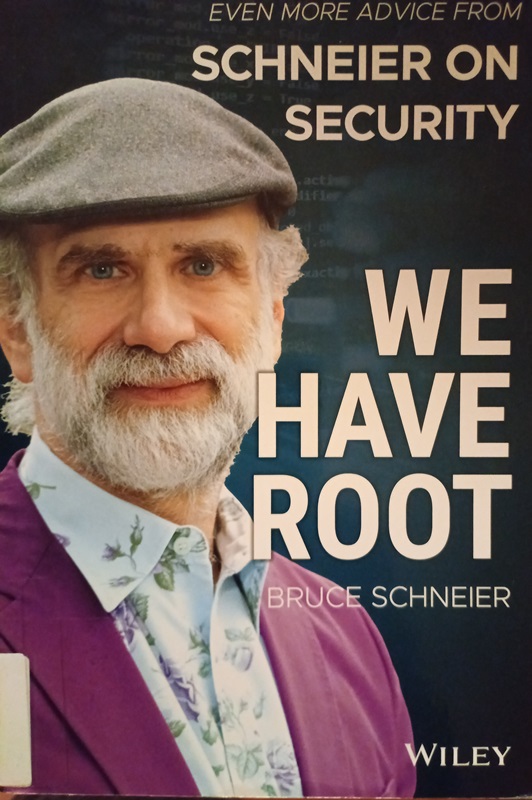
“Skype – owned by Microsoft – was changing its protocols to make it possible for the government to eavesdrop on users, Corporate Vice President Mark Gillett took to the company's blog to deny it. Turns out that wasn't quite true. Or at least he – or the company's lawyers – carefully crafted a statement that could be defended as true while completely deceiving the reader. You see, Skype wasn't changing its protocols to make it possible for the government to eavesdrop on users, because the government was already able to eavesdrop on users.” We Have Root 2019, @ pg. 99 [Originally published in CNN.com, July 31, 2013].
Quote:
“At a senate hearing in March, Director of National Intelligence James Clapper assured the committee that his agency didn't collect data on hundreds of millions of Americans, He was lying, too. He later defended his lie by inventing a new definition of the word “collect,” an excuse that didn't even pass the laugh test.” We Have Root 2019, @ pg. 99 [Originally published in CNN.com, July 31, 2013].
Quote:
“Google and Facebook insist that the NSA has no “direct access” to their servers. Of course not; the smart way for the NSA to get all the data is through sniffers.” We Have Root 2019, @ pg. 99 [Originally published in CNN.com, July 31, 2013].
Quote:
“Ronald Reagan once said “trust but verify.” That works only if we can verify.” We Have Root 2019, @ pg. 100 [Originally published in CNN.com, July 31, 2013].
Quote:
“Accountability means that those who break the law, lie to Congress or deceive the American people are held accountable. The NSA has gone rogue [...]” We Have Root 2019, @ pg. 101 [Originally published in CNN.com, July 31, 2013].
Quote:
“The NSA has repeatedly lied about the extent of its spying programs, James R. Clapper, the director of national intelligence, has lied about it to Congress.” We Have Root 2019, @ pg. 104 [Originally published in TheAtlantic.com, September 4, 2013].
Quote:
“Comparisons are springing up between today's NSA and the FBI of the 1950s and 1960s, and between the NSA Director Keith Alexander and J. Edgar Hoover. We never managed to rein in Hoover's FBI – it took his death for change to occur. I don't think we well be so lucky with the NSA.” We Have Root 2019, @ pg. 106 [Originally published in TheAtlantic.com, September 4, 2013].
Let's review a few important highlights. If memory stands correctly was it not President Obama in office in 2013 to whom James Clapper would have reported either directly or via a dotted line? Was not the theme of President Obama – “Hope?” How can one have “Hope” when the government is spying on you and violating your civil rights?
And to what extent did these programs continue under President Trump's first term and the, now, first term of President Biden. As to the latter it is more than reasonable to assert that such programs have escalated under President Biden evident by the WOKE agenda which is nothing more than a government sanctioned form of spying cloaked around the gang land myth of “Social justice.” As for President Trump not much is stated with respect to how privacy has been affected under his first term; but, it is more than reasonable to suggest that President Trump is going to have a problem to deal with in terms of reestablishing public trust with respect to the messes made as confirmed under Presidents Obama and Biden – both staunch Democrats -- and balancing genuine legitimate national security interests. Hey wait a minute, aren't the Democrats for the “Little guy,” and “Civil rights?” [Looking up at the ceiling, boy it's getting late now isn't it.]
Let that digest for now. More to come.
Editorial Note:
Legalhotwater converges law, politics, and social issues into information readily available for consumption by the general public. Legalhotwater requires no email sign up, like others, to track your behaviors, no annoying pop-ups, no pay to read requirements, no persistent pandering of your dollars, nor do we require any enlistment within a religious sect or otherwise impose religious beliefs upon anyone. Instead Legalhotwater provides unbiased content and opinions with the aim of informing the public leaving the ultimate decision to act or not in the hands of the reader, as it should be.